A New State Gemstone for Louisiana

For those who feel that the agate gemstone doesn’t properly represent the dynamic coastal culture of Louisiana, you may get your wish. To be voted on in June, Louisiana may get a new state gemstone: LaPearlite. If you haven’t heard of this gemstone, don’t be surprised, as it’s a new stone that was just discovered by gemologist Anne Dale.

Anne Dale and her husband, a jewelry craftsman, have been working on this gemstone to make it a commercial beauty. Together, they cut and polished the stone and found a new technique that could be derived from it. This new gemstone material comes from the shell of the American Oyster, which is abundant off the coast of Louisiana.

In fact, the American Oyster is the most important consumer mollusk in the US and it may be the key to bringing back consumer popularity in the oyster industry since the 2010 BP Oil Spill. Anne Dale confirms that the LaPearlite is the most beautiful stone she’s seen, and the way it takes in the light is spectacular. She feels that this very stone is a true representation of the diversity that exists off the Gulf Coast.

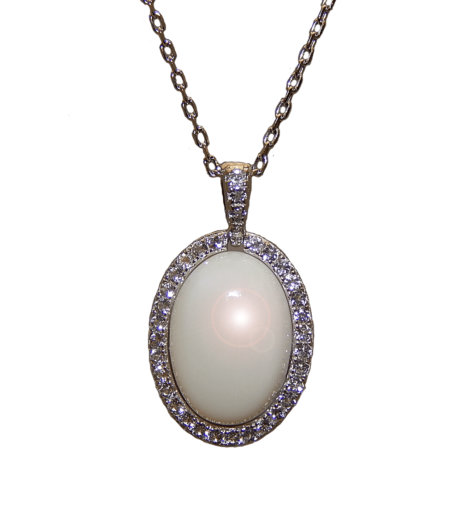
Currently, the Pearlite exists in a stunning ring and reflects the ambiance of the coastal sun. In an effort to bring back the oyster industry that took a hit last year, a vote in the Louisiana House may change the gemstone of Louisiana from agate to LaPearlite. Some fear that this stone is too commercial, while others feel it will be the perfect representation of a coastal culture rich in oysters and other sea creatures.

Source: Visit Louisiana

Continue reading →


GIA GIA’s Gems & Gemology the quarterly scientific journal of the Gemological Institute of America featured  Louisiana LaPearlite® in the Summer 2018 edition. Derived from the organic shell of the Crassostrea virginica (American Oyster) the most important consumer mollusk in the United States, a species predominantly found in the waters of coastal Louisiana.

Anne Dale develop a process that allows a gemstone to be derived from the shell of the species. A Louisianacabochon cut gemstone from the shell of the Crassostrea virginica known as LaPearlite® became the Official Louisiana State Gemstone in 2011 .

While beauty is said to be in the eye of the beholder, beauty really starts in the mind;  perhaps that is why “common things” are often taken for granted… until they are taken from us. The purist of whites, to a gentle flow of golden wispy veils – in its final splendor each LaPearlite® is uniquely born of the sea.

The scientific research and article was conducted\authored by Artitaya Homkrajae gemologist at GIA in Carlsbad, California.

LEARN MORE


Gemologists live for the fire, the sparkle, the brilliance of stones. Measured in degrees of reflection, refraction and dispersion, the effect of light on a diamond is a defining characteristic of brilliance.

But the brilliance of one Louisiana gemologist shines brighter than any stone in her case. Anne Dale, GIA Graduate Gemologist, Professional Gemologist-Columbia School of Gemology, Fellow of the Gemological Association of Great Britain, and owner of Anne Dale Jewelry in Mandeville, LA combined her love for gemology and compassion for others to create Jeweler for a Cause – an original collection of jewelry created to raise money, awareness and the spirits of people in need. This philanthropic line not only highlights Anne’s design talents, but it also incorporates her love for the community. Add that to her Italian heritage and you’ve got a formula for brilliance beyond compare.

Jeweler for a Cause began when Hurricane Katrina overwhelmed the Gulf Coast in 2005. Anne and her husband Mike Dale watched their community fall to its knees as the flood waters destroyed everything in their path. Living through the aftermath of the 6th most intense Atlantic hurricane ever recorded took its toll on Anne, as she watched family, friends and community put their lives back together. Anne saw the bad, but she also found the good. Katrina survivors walked away with a greater sense of community. Anne walked away forever changed.

The emotional impact motivated her to draw from the two things she knew best – jewelry and her compassionate heart. In 2006 she established Jeweler for a Cause to focus on the many philanthropic causes she endorsed.

“Jeweler for a Cause exists for three reasons,” she said. “We seek to provide heightened awareness of the cause, funding for the cause and caring for others in need.”

For eight years Jeweler for a Cause has come alongside large and small organizations such as Catholic Charities, House of Blues, Disney Epcot, TABASCO and the Easter Seals Foundation to shine the light on those in need. And each custom designed peice comes with its own unique story that will inevitably touch your heart.

“My first collection was born out of a need for cultural healing of my hometown in the aftermath of Katrina,” says Anne. “I created the Katrina Relief Badge in sterling silver with the theme, ‘I know what it means to love New Orleans.’ I think it was inspired by God. Within 3 days we had 700 hits on our website and Dan Akroyd was asking to purchase 500 of the pins. The proceeds went to the victims of that killer hurricane.”

Anne-autism-AprilAnne expanded the collection to include other New Orleans pieces like ‘Return to New Orleans’ and ‘Pray for the Gulf Coast.’ These pieces went on to raise more than $175,000 in hurricane relief.

Riding on the heels of the hurricane relief line, Anne pulled from her personal experience for the 2nd Jeweler for a Cause line. Called the ‘Self-esteem’ pendant, Anne poured her heart into creating a visual representation of the emotional pain associated with vascular birthmarks. Watching her own son, Stephen, deal with the pressure of looking different touched her heart as he struggled to find his significance outside of his external appearance.

“I believe the pressure placed on our youth today to be perfect has never been higher,” she says. “This pendant sends the message, ‘you are beautiful just the way you are.’”

It didn’t take long for Anne to realize that young girls from junior high to college struggle in this area too. The back of the sterling silver pendant is engraved with ‘Beauty Comes From Within,’ and it wasn’t long before young girls became her target audience. Like the first Jeweler for a Cause piece, a portion of the proceeds from the self-esteem piece go to charity.

Anne has since created many other custom lines for Jeweler for a Cause. The Perseverance Pin, is closely tied to the battle with cancer. The Facing Autism pendant, which moves from puzzle piece to the profile of a child, highlights the knowledge and goodness within all children. And the Star of Hope, which combines the Silver Star (3rd highest award given for valor) and the Yellow Ribbon, benefits groups helping military men, women and their families throughout the world.

“One of the most memorable moments from my Jeweler with a Cause line is when I pinned the Star of Hope on Oliver North at the New Orleans D-Day Museum event,” Anne recalls. “I created that piece after Matt Cole, a Mandeville native who was struck by a mortar round launched by insurgents, inspired me. Cole’s spinal cord and lungs were injured and, today, he works with other veterans ensuring they receive all benefits afforded them for their service to their country, and he does it from his wheelchair.”

But perhaps her most significant contribution to date has been her creation of LaPearlite, the state gem of Louisiana. Born out of the Gulf oil spill, Anne’s commitment to her local seafood industry triggered those creative juices. While shucking oysters in her back yard the beautiful pearl-coated shells caught her eye. That led her to try and mine the stone out of this very specific type of oyster (Crassostrea Virginica) that is native to the Gulf Coast. The result was a beautiful organic gemstone from the oyster shell that has luster and differing shades of white and mother of pearl look that swirl throughout each gemstone. In 2011 the LaPearlite became the official Louisiana State Gemstone when it was signed into law by Governor Bobby Jindal.

Like the brilliant stones that surround her, Anne Dale reflects the love and generosity she has toward her neighbors and her community. The many facets of her philanthropic line highlight not only her caring nature, but also her gemological and design talents. If we measured brilliance in the lives of those around us, Anne Dale’s would be classified as a Super Ideal Make.

Be sure to check out Anne’s many contributions at Annedale.com, Jewelerforacause.com and Lapearlite.com.

SOURCE: Southern Jewelry News


Louisiana new gemstone boost seafood industry

A mountain of oyster shells stands inside the gate at Wilson’s Oyster Co. in Houma. Like other processors of the mollusk, once the vitamin and protein-rich meat, documented as low in cholesterol and used in the treatment of some cancers, is extracted for consumption they look for other uses of the leftover covering.

In this case, crewmember Sterling Liner explained that the apparent multiple dump truck loads by-product from Wilson’s processing is sold to various companies for as many uses. “Some guy from Missouri or someplace is gonna’ take all this and make chicken feed from it,” Liner said. “It helps make the egg shells stronger.”

Making use of oyster shells after the contents have been processed or eaten raw is nothing new. For centuries coastal inhabitants made the stony coverings into sharp tools. Oyster shells have been used to pave roads. They are even beneficial to replenish reefs for fishing habitats.

Artists often use oyster shells as their canvass, and craft makers find creative ways to bring aesthetic appreciation to the raw material.

Gardeners know that powdered oyster shells can control slugs, benefit roses and boost production of other plants.

Scientists have even determined that calcium from oyster shells makes a positive dietary supplement for both humans and livestock.

Louisiana may now profit from a new and first time application for shells of the Crassostrea virginica oyster, one of dozens of mollusk varieties, which has replaced the agate as the new state gemstone and the state’s first ever official mineral.

Gemologist Anne Dale of Mandeville has cut the specific species of oyster shell, common off the shore of Louisiana, as cabochon gem and used it in making jewelry for the first time ever.

“It was last year after the oil spill,” Dale said of when the idea hit her. “I went and bought a lot of seafood, oysters especially. I was shucking them in the backyard and the sun hit the shell. I kept thinking, ‘I don’t know why no one has ever cut a gemstone from this shell.’ So I did it. It was an inspirational moment. I thought, ‘It is so pretty.'”

Dale developed a process that she declined to reveal, as the patent is pending, and gained immediate notoriety as the first person ever to successfully achieve a cabochon cut, a domed top with a flat bottom, from a mollusk shell.

With her contacts in the jewelry business, cutting the Crassostrea virginica oyster shell into a true gem gained global attention and a sampling of the finished gem was entered into permanent display among the Smithsonian Institution National Museum of Natural History’s U.S. National Gem Collection on May 23.

Louisiana state Rep. Scott Simon (R-Abita Springs) picked up on what Dale had done and sponsored HB-246 during the past legislative session to designate this specific oyster shell as the state’s new official mineral and gem. Gov. Bobby Jindal signed HB-246 into law on June 27 with an effective date of Aug. 15.

“For one thing it is going to at least bring conversation to the plight of the seafood industry,” Simon said. “It is going to be promoted with the [Louisiana] bi-centennial [in 2012]. The main thing about this is that it is getting worldwide recognition as a new gemstone. People come down and enjoy our seafood and have a good time, but go home and all they have is memories. But in this way they can bring a little bit of that seafood back home with them. It will always generate conversation and interest. It will also bring greater awareness to the Louisiana seafood industry.”

“The beauty of these shell linings were appreciated by a very discerning connoisseur of oysters,” Scottish Gemological Association President Alan Hodgkinson said of Dale’s creation in a printed statement. “Here is a natural resource that [in addition to offering raw material for a new product application] can do good in creating jobs and contributing to the local economy. … After all the coastal inhabitants [of Louisiana] have been through these last years, what a heaven-sent gift for one and all.”

The idea behind designating the cabochon cut from the Crassostrea virginica mollusk as the official gem is one intended to boost tourism and enhance the already versatile oyster market.

“It’s great. It really is,” said Houma-based Motivatit Seafood Inc. CEO Mike Voisin. “I think what [having this oyster shell recognized for this gemological value] will do is it will help others recognize the intrinsic value of the oyster and its shell.”

“There are a lot of different elements involved,” Dale said. “Although it is bountiful in Louisiana, not every shell will produce a cabochon cut. A good shell has a lot of good things. It does take time to cut.”

Dale said on average, thus far, going from raw product to a finished gem is a full day process. The gem can then be placed into settings for various adornments. Retail prices for this gem are in a mid-level range from $250 to $2,000 per completed piece of jewelry.

Not every shell or rock can be classified as a gem. There is no universally accepted grading system for gems according to the U.S. Geological Survey. However, within the jewelry industry, Dale said, there are certain things that constitute a gem. “It has to possess rarity, durability, beauty and symmetrical shape,” she said.

A gem is generally defined as a piece of mineral that is cut and polished to form a usable piece of jewelry or adornment. “All gems are minerals,” Dale said. “The value includes the time and labor cutting it, and the aragonite in it.”

“I don’t know what all she does to it,” Voisin said. “[But] I think it will mean a very positive public relations piece for the seafood and oyster community. Just making the gem will help the economy and make people think of Louisiana. I think there are many positive sides to it.”

While some in the oyster industry and jewelry business were surprised about the shell development, most questioned confirmed that the gemological use only adds to the versatility of a natural resource.

The overall profitability of designating the Crassostrea virginica oyster shell as the state mineral and its cabochon cut as state gem might still be unknown. The anticipation is that the benefits won’t be just chicken feed.

Source: Houma Times